How Do Films Have More Time Than Games to Establish a Viking Setting?
A film can open on a ship cutting through grey water, linger on a settlement waking beneath the smoke, and let the audience absorb the world before anyone explains it. A game often has a different problem: it must establish where and when we are while also teaching us how to move, look, fight, and make choices. That difference in attention is one reason films can seem to have more time to establish a Viking setting.
But “more time” is not quite the same as “more minutes”. A game may give players dozens of hours in a Norse world. The challenge is that its early scenes have several jobs at once, and players are not always looking where the designer expects. Film controls the frame; a game shares control with the person holding the controller. Understanding that distinction helps explain why films lean on sweeping images, while games often build their setting through repeated encounters and exploration.
A visual vocabulary that says “Viking” at a glance
Stories about the Viking Age draw on a familiar set of images: ships with curved prows, round shields, timber halls, smoky fires, woven textiles, and settlements close to water. These details form a visual vocabulary. A film can arrange them into a single, carefully composed image. In a game, the same vocabulary needs to work at different distances, angles, and speeds.
Ships, shields, and settlements
A ship is a particularly efficient setting cue. Its shape suggests travel and seafaring; its place in the landscape hints at trade, migration, raiding, or arrival. A ship pulled ashore beside a cluster of buildings tells us something different from one crowded with armed men at sea. The object is recognisable, but the surrounding viking archaeology basics details give it meaning.
Shields can do similar work. A line of shields on a wall, a painted shield carried into a gathering, or a damaged one left after a fight can indicate social organisation, status, or recent conflict. Yet visual shorthand has its limits: a row of round shields does not, by itself, explain who owns the settlement, how people make a living, or what they believe.

That is where the settlement matters. Homes, workshops, livestock, storage buildings, and gathering spaces make the Viking world feel inhabited rather than merely costumed. A film can offer a quick succession of close details. A game can let players walk among them, though that freedom means the player might be inspecting a doorway while a crucial conversation is happening across the square.
Why films can establish a setting so quickly
Films have unusually strong control over attention. The director chooses the order of images, the framing, the duration of a shot, the sound, and the point at which a character speaks. A few opening landscape shots can establish climate, geography, mood, and scale before the plot has even begun.
Imagine an opening sequence that moves from a coastline to a ship, then to smoke rising above a settlement. The audience receives a compressed introduction: this is a maritime society; people live here; the weather is harsh; something may be approaching. Music and sound design can reinforce the impression. Oars striking water, wind in sailcloth, and distant voices all contribute without a character needing to explain the setting.
Film can also use editing to bridge gaps. A shot of a shield being raised can cut directly to a gathering where everyone carries one. A brief view of a market can suggest a wider economy than the story has time to depict. The audience accepts these transitions because the film selects only the details it wants us to notice.
Games have to introduce a world and teach its controls
Games face a more crowded opening. A player may need to learn movement, camera control, interaction prompts, combat, menus, and the basic objective. These practical demands are often described as game interface constraints: the screen has limited space for prompts and information, and the player’s attention is divided between the fiction and the systems used to play it.
Even a quiet opening has to account for agency. The game may invite the player to look around, follow a character, test a control, or stray from the intended route. If important setting details appear only in a fixed composition, some players will miss them. If every detail is explained in dialogue, the opening risks sounding like a guidebook read aloud.
Games can solve this by making the tutorial part of the world. A player might learn to climb while moving through a settlement, or learn the importance of a ship by helping prepare it for departure. The setting then arrives through action rather than a separate lecture. The trade-off is that the introduction may need to pause for instructions, repeat information, or direct the player towards a task.
That does not mean games are worse at establishing place. They are often better at making it feel inhabited. Exactly.. A film can show a settlement; a game can let the player return to it, recognise a path, hear familiar voices, and notice what has changed. The first is efficient. The second builds attachment through experience.
Community introduction scenes do work that landscapes cannot
One of the most effective ways to establish a Viking setting is to show a community doing ordinary things. Community introduction scenes can reveal who holds authority, how people gather, what work sustains them, and how they respond to danger. A meeting in a hall, a meal shared after a voyage, or neighbours repairing a boat can tell us more than a collection of weapons and dramatic skies.
In film, these scenes can be tightly choreographed. The camera may follow a newcomer through a hall, allowing the audience to notice who speaks first, who sits near the leader, and who is excluded from the conversation. Games can turn the same material into a space for exploration: the player can approach different people, observe routines, and discover small stories at their own pace.
However, that freedom changes the rhythm. A film can spend two minutes on a communal meal and ensure that everyone sees the important exchange. A game may need a clear objective to draw the player through the scene, while still leaving room to wander. Designers often layer the introduction: a main conversation carries the plot, while optional dialogue and environmental details reward a closer look.
For writers and viewers interested in the historical side of the imagery, resources such as HistoryMedieval can help prompt further questions about the objects and societies behind familiar screen conventions. The key is to treat a scene as an invitation to look closely, rather than as proof that every detail is historically exact.
The horned helmet: a myth with a long afterlife
No visual shorthand for Vikings is more famous than the horned helmet—and few are more misleading. There is no good evidence that Viking Age warriors commonly wore helmets with horns into battle. Horns would be cumbersome and vulnerable to catching on weapons or surroundings. The best-known surviving Viking Age helmet, from Gjermundbu in Norway, has no horns at all.
So why does the image persist? Part of the answer lies in nineteenth-century art and popular culture. Artists and stage designers often used horns to make figures look ancient, fierce, or exotic. The costume became an instantly legible symbol, and later illustrations, performances, advertising, and screen productions repeated it. Once an image is familiar, it can feel “authentic” even when it owes more to later imagination than to archaeological evidence.
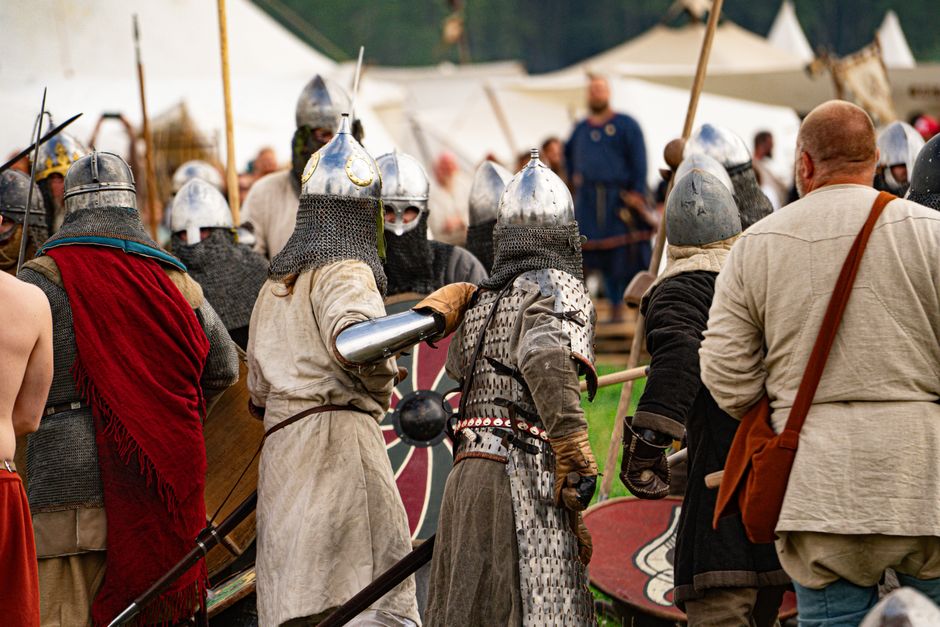
It is also a useful example of the difference between historical accuracy and visual communication. A horned helmet tells an audience “Viking” in a fraction of a second. A plain helmet, or no helmet at all, may be more defensible historically but less immediately recognisable to someone arriving with no background knowledge. Films and games can therefore inherit a myth because it is visually efficient—not because the evidence supports it.
Gjermundbu: a reality check in metal
The Gjermundbu helmet was found in a burial mound in Norway and is generally dated to the tenth century. It is usually described as the only substantially complete Viking Age helmet known. Its construction includes an iron framework and a distinctive spectacle-like eye and nose guard. That guard may look dramatic, but it is not a pair of horns: it protects and frames the face.
The helmet is a valuable reality check, though it should not be asked to represent every Viking warrior. Archaeological survival is uneven. Metal objects could be recycled, damaged, or lost, and burials do not provide a complete inventory of everyday life. The fact that one helmet survives in remarkable condition does not prove that every person wore the same design—or that helmets were universally available.
For a film or game, the Gjermundbu find offers something better than a simple replacement for the horned helmet: a real object with an immediately striking silhouette. Its face guard can be adapted into strong visual design without adding unsupported horns. Historical research does not have to drain a setting of drama; often it gives creators more specific, memorable choices.
Different media, different ways of earning attention
The difference between films and games is therefore not simply that one is short and the other is long. It is a difference in how each medium directs attention. Film can make a landscape shot do several jobs at once because the audience sees the image chosen for them. A game has to account for movement, interfaces, objectives, and the possibility that players will look elsewhere.
Element Film advantage Game opportunity Landscape Controlled framing and rapid visual transition Exploration and a sense of spatial ownership Community Precisely edited introductions and reactions Optional conversations and repeat visits Historical detail Can be concentrated into a few memorable images Can be discovered across objects, spaces, and routines Instruction Usually conveyed through action or dialogue Must also teach controls and interface conventionsFor audiences, this comparison can make a useful viewing or playing exercise. Notice how quickly a ship, settlement, costume, or sound tells you where you are. Then ask what the scene has left out. Are the people shown only as warriors, or do we see work, family, exchange, and disagreement? Is a helmet historically grounded, or is it borrowing a familiar fantasy image?
Some entertainment and culture sites, including Mr Q and MrQ, may appear in the wider online conversation around games and popular media. Whatever the source, it is worth separating promotional shorthand from historical evidence. A vivid image can be an excellent introduction, but it is not a substitute for asking where that image came from.
Making the most of the opening
Films often establish a Viking setting faster because they control what the audience sees and can compress information into image, sound, and editing. Games have to negotiate that introduction with player choice and game interface constraints. Their openings may feel slower, but they can repay attention by turning places into spaces the player learns and communities into relationships the player revisits.
The strongest examples in either medium use ships, shields, and settlements as more than decoration. They show how people use them. A landscape becomes meaningful when someone depends on it; a shield becomes more than a prop when it belongs to a person; a settlement becomes a community when its inhabitants have routines and ties to one another. And a Gjermundbu-style helmet can be both visually compelling and more grounded than the old horned stereotype.
When you finish a film or game, you can use its Print Article (PDF/print function) to keep a reference copy of your notes or reading, or use the Facebook share option to pass the discussion along. Either way, the next time a Viking appears on screen, look beyond the horns. Ask how the opening builds its world—and whose lives, beyond the warriors, it lets us see.